rv-park
Berry's Grove Campground
Tyngsborough, MA (~7 mi north of Lowell, on Lake Mascuppic)
A small year-round, RV-only campground with 24 50-amp full-hookup lakeside sites that primarily caters to long-term and monthly residents.
Tiny homes in Lowell, Massachusetts — zoning rules, THOW parking, builder costs, and what you need to know before buying.
Last researched May 2026
Lowell is one of the friendlier Massachusetts cities for foundation ADUs. The city follows the statewide by-right framework directly without adding owner-occupancy requirements or heavy parking mandates, and construction costs are meaningfully lower than in the immediate Boston metro — roughly $225–$325 per sq ft. The MBTA Lowell Line provides direct commuter rail service to Boston, which both waives ADU parking requirements near the station and supports strong rental demand. Lowell has been explicit in published guidance that ADUs remain secondary to the primary dwelling but otherwise faces few local obstacles. THOW full-time living is not a practical option within the city; the closest year-round options are across the New Hampshire border.
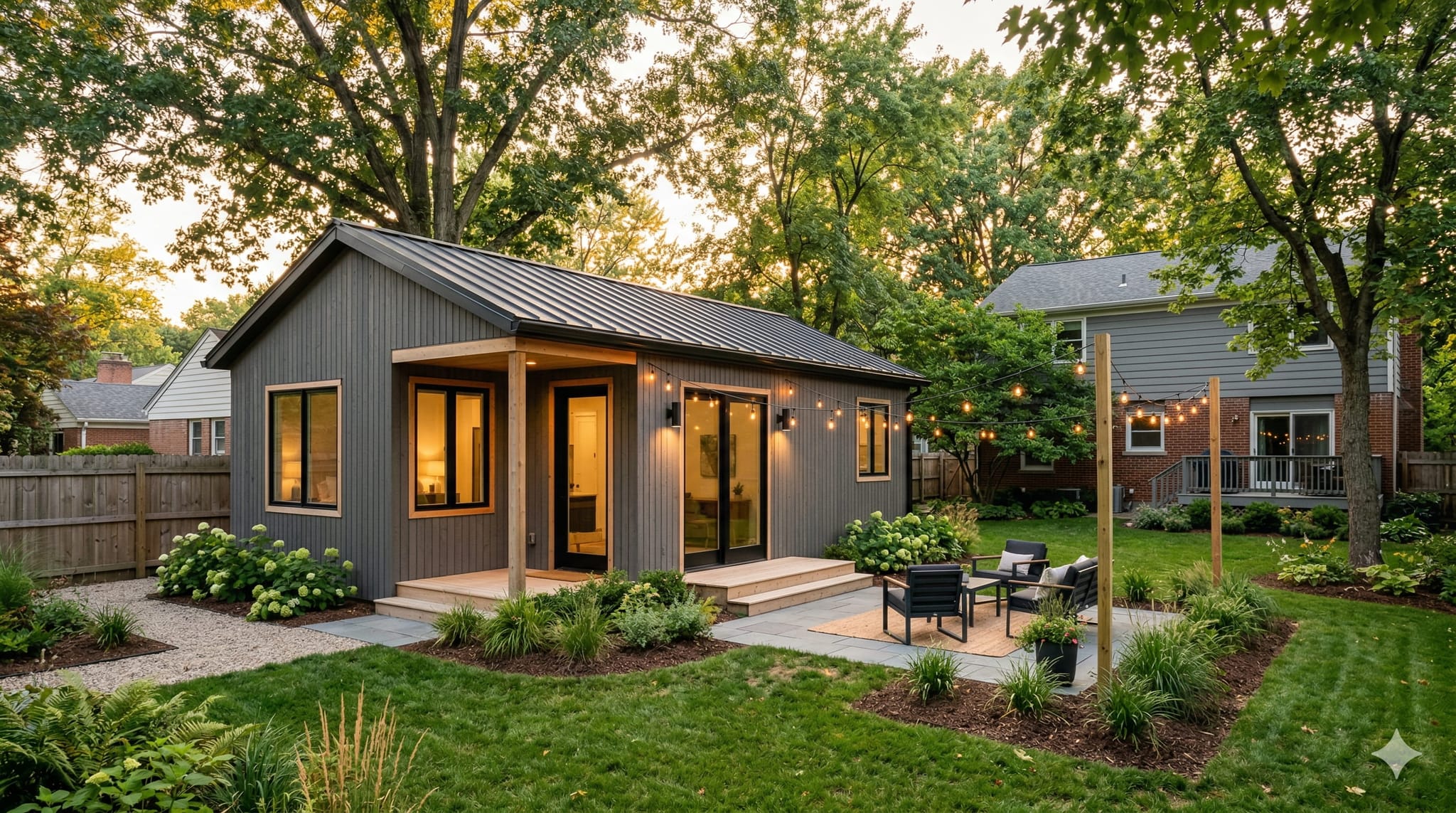
Lowell fully implements the statewide Affordable Homes Act (Chapter 150, Acts of 2024). ADUs up to 900 sq ft are allowed by-right in every zoning district that permits single-family homes — internal conversions, attached additions, and detached structures (including converted garages and carriage houses) all qualify. The size cap is 900 sq ft or 50% of the primary dwelling, whichever is less, with a 350 sq ft minimum per state health code. Lowell does not layer owner-occupancy requirements, excessive parking mandates, or special-permit triggers on top of the state rule, making it one of the more straightforward MA cities for ADU approval. A building permit, plumbing permit, electrical permit, and Certificate of Occupancy are required from the Lowell Division of Development Services. Tiny homes of 400 sq ft or less on permanent foundations can use the Appendix AQ pathway from the 10th Edition of 780 CMR. THOWs are classified as recreational vehicles and cannot serve as primary residences on standard residential lots. Verify current requirements with your local planning department before purchasing land or beginning construction.
Verify current requirements with your local planning department.
Lowell implements the statewide ADU law directly and adds minimal local friction. ADUs up to 900 sq ft or 50% of the primary dwelling (whichever is less) are by-right in all single-family districts, with a 350 sq ft minimum. Internal, attached, and detached ADUs all qualify. No owner-occupancy requirement. One off-street parking space per ADU is required unless the property is within 0.5 miles of an MBTA commuter rail or LRTA transit stop — the Gallagher Terminal/Lowell Station area covers much of downtown. Short-term rentals (under 31 days) of ADUs are prohibited unless expressly allowed by the city. Permits go through the Lowell Division of Development Services.
Communities, RV parks, and parking options in and near Lowell.
THOWs are not permitted as primary residences on standard Lowell residential lots. Massachusetts classifies THOWs as recreational vehicles and Lowell follows that interpretation. There are no year-round RV parks in Lowell. Regional options are mostly seasonal; the closest year-round extended-stay RV accommodations are in southern New Hampshire and central Massachusetts. Rural private land in northern Middlesex County and neighboring southern New Hampshire offers more permissive rules for RV occupancy, subject to local ordinances.
rv-park
Tyngsborough, MA (~7 mi north of Lowell, on Lake Mascuppic)
A small year-round, RV-only campground with 24 50-amp full-hookup lakeside sites that primarily caters to long-term and monthly residents.
co-housing
Berlin, MA (~35 mi southwest of Lowell)
Two adjoining cohousing neighborhoods totaling 68 LEED-influenced homes on a 65-acre site with 50+ acres of preserved open space and conservation land.
Adams, Massachusetts
Adams, Massachusetts-based tiny home manufacturer, one of the largest in the Northeast. Builds custom tiny houses on wheels and foundation models from a 20,000-square-foot facility with approximately 50 employees. Founded in 2016 by three Adams residents who pivoted from traditional homebuilding to tiny homes.
Service areas: Massachusetts, Connecticut, Rhode Island, Vermont, New Hampshire
Brunswick, Maine
Brunswick, Maine design-build company (founded 2019) specializing in net-zero-ready oversized tiny homes and ADUs from 525 to 1,000 sq ft. Combines prefab panel construction with on-site finish work. Serves Maine and Massachusetts.
Service areas: Maine, Massachusetts
Fitzwilliam, New Hampshire
New England-based NOAH-certified tiny home builder delivering across NY and New England. Builds both THOW and foundation models with rigorous structural, energy efficiency, and legal compliance standards. NOAH certification simplifies financing and insurance for buyers. Custom homes available alongside in-stock models.
Service areas: New York, New Hampshire, Vermont, Massachusetts, Maine, Rhode Island, Connecticut
Auburn, Massachusetts
Auburn, Massachusetts factory-built tiny home brand from Brady-Built, a home construction company in business since 1979. Offers RV-style tiny houses on wheels (21, 25, and 31-foot) and stationary park model homes. Signature curved mortise-and-tenon wood beams; 25-year warranty. Serves Massachusetts, Rhode Island, Connecticut, New Hampshire, and Vermont.
Service areas: Massachusetts, Rhode Island, Connecticut, New Hampshire, Vermont
Portland, Maine
Portland, Maine design-build firm launched in 2013 by Kaplan Thompson Architects, offering net-zero-ready prefab and modular homes. Four purpose-built ADU designs (Torrey, Highland, Sterling, and Jordan) start around 420 sq ft and suit backyard placements. Typical turnkey cost runs $450–$600 per sq ft. Serves all of New England, the Mid-Atlantic, and as far west as Ohio through manufacturing partners in Maine, New Hampshire, and Pennsylvania.
Service areas: Maine, New Hampshire, Vermont, Massachusetts, Connecticut, Rhode Island, New York, New Jersey, Pennsylvania, Ohio
Waltham, Massachusetts
Waltham-based Mass Tiny Homes is a custom ADU company serving Massachusetts, Connecticut, and Rhode Island with attached and detached tiny homes. The company focuses on turnkey custom ADU services for rental income, guest space, multigenerational housing, and home offices.
Service areas: Massachusetts, Connecticut, Rhode Island
A comparison between tiny-home living and conventional homeownership in Lowell.
Tiny home path
Traditional home path
Potential monthly savings
Verified links for planning, permitting, and community connections in Lowell.
Yes. Lowell follows the statewide Affordable Homes Act directly — ADUs up to 900 sq ft are by-right in all zoning districts that allow single-family homes. No special permit, variance, or public hearing is required for a qualifying ADU.
No. Lowell does not require the owner to live in the primary home or the ADU, which makes it more flexible than some other MA cities. Short-term rentals (under 31 days) of ADUs are still prohibited unless the city expressly allows them.
Yes. A detached accessory structure such as a garage or carriage house is an eligible ADU configuration in Lowell, provided the converted space meets full residential building code (insulation, plumbing, electrical, egress) and the 350–900 sq ft size range.
Expect $175,000–$350,000 for a foundation ADU at roughly $225–$325 per sq ft. Internal conversions of existing basements or attics start lower, near $110,000–$140,000.
Guides, zoning explainers, and financing articles related to this state.
Everything you need to know about living in a tiny home in California — legal pathways, best cities, costs by region, builders, financing, insurance, and off-grid options. Updated for 2026 laws.
A state-by-state breakdown of tiny home zoning laws, THOW regulations, ADU rules, and where tiny homes are easiest to place legally in 2026.
A state-by-state overview of tiny home zoning laws, covering the most friendly and most restrictive states for THOW and foundation tiny home placement.