RV park with long-term monthly rates
Albuquerque Central KOA
Albuquerque
Tiny homes in Albuquerque, New Mexico — zoning rules, THOW parking, builder costs, and what you need to know before buying.
Last researched April 2026
Albuquerque offers the broadest tiny-home infrastructure in New Mexico: a well-defined ADU pathway under the IDO, several long-term RV parks that accept THOWs, and a lower cost of living than Santa Fe or most Western metros. The high-desert climate (hot dry summers, cool winters, roughly 9 inches of annual precipitation) is well suited to passive solar and low-maintenance small dwellings. The Nob Hill, North Valley, and South Valley neighborhoods have the largest stock of older single-family lots where a backyard ADU is most practical. Foodies, hikers, and balloon-fiesta regulars will find the lifestyle a strong fit; buyers expecting dense walkable urbanism should calibrate expectations — Albuquerque is a car-first metro.
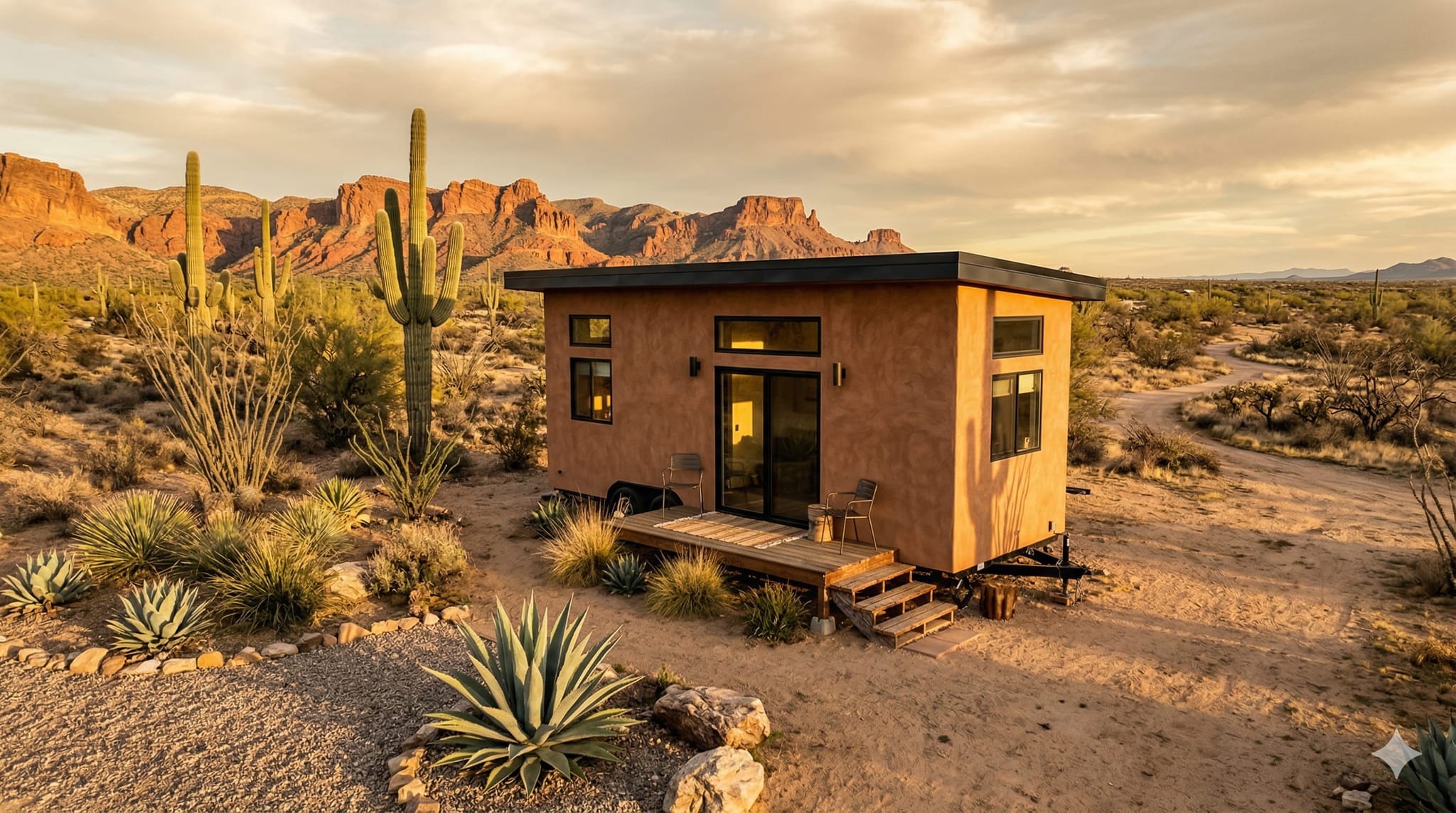
Albuquerque regulates residential development through the Integrated Development Ordinance (IDO), most recently updated by ordinance O-26-2, adopted by the City Council on February 18, 2026 and applied to applications submitted on or after April 20, 2026. The IDO permits one accessory dwelling unit (ADU, also called a casita) on every single-family lot in the R-A and R-1 zone districts, and as an accessory use in R-T, R-ML, MX-T, MX-L, and MX-M mixed-use zones. ADUs are capped at 750 sq ft, cannot exceed 25% of the combined side and rear yard area, cannot be taller than the primary dwelling, and must observe a 5-ft rear or side setback plus a 10-ft inter-building separation for fire safety. One off-street parking space is required.
For foundation tiny homes, Albuquerque enforces the 2018 IRC with Appendix Q through the Construction Industries Division, which permits habitable dwellings as small as 120 sq ft. A full Appendix Q-compliant tiny home can be permitted as an ADU on a qualifying single-family lot, which is the most realistic in-city path. THOWs are classified as travel trailers or RVs by the NM MVD and cannot be used as a permanent primary dwelling on a standard Albuquerque residential lot; long-term RV park placement in Bernalillo, Rio Rancho, or Moriarty is the common workaround.
As of April 2026 the city is actively promoting ADU production through its Housing Forward ABQ initiative. Verify current requirements with your local planning department before purchasing land or beginning construction.
Verify current requirements with your local planning department.
One ADU allowed per single-family lot in R-A and R-1 zones by right under the IDO. Maximum size 750 sq ft; cannot occupy more than 25% of the side+rear yard area; 5-ft setback from rear or one side; 10-ft separation from buildings on adjacent lots; cannot exceed the primary home height; one off-street parking space required. ADUs are also permitted as an accessory use in R-T, R-ML, and select mixed-use zones. The 2026 IDO update (O-26-2) clarified and expanded these allowances; applications submitted on or after April 20, 2026 are reviewed under the updated text.
Communities, RV parks, and parking options in and near Albuquerque.
THOWs are treated as RVs under Albuquerque zoning and cannot serve as a permanent residence on a standard residential lot. Full-time placement is limited to licensed RV parks and long-term campgrounds, with monthly rates typically $300-$550/mo including water and sewer (electricity metered separately). Albuquerque Central KOA and several parks in adjacent Bernalillo and Rio Rancho are the most common long-term options. Occasional backyard parking of a THOW as a temporary guest unit is not explicitly authorized in the IDO and should be verified with Planning before attempting.
RV park with long-term monthly rates
Albuquerque
Route 66 RV park, monthly rates available
West Albuquerque
Guin, Alabama
Guin, Alabama manufacturer of energy-efficient manufactured and modular homes, founded in 2004. Operates a 200,000-square-foot facility and has produced 15,000+ homes across 18 states. Offers a "Cozy Cabins" tiny-home line within its Signature series, built to HUD code or state modular standards. Member of the Alabama Manufactured Housing Association. Active as of May 2026.
Service areas: Alabama, Arizona, Arkansas, Florida, Georgia, Illinois, Indiana, Kentucky, Louisiana, Mississippi, Missouri, New Mexico, North Carolina, Oklahoma, South Carolina, Tennessee, Texas, West Virginia
Santa Fe, New Mexico
Santa Fe design-build manufacturer producing CNC-fabricated tiny houses, prefab panels, ADUs, and outbuildings. Founded in 2015 by licensed contractor Zane Fischer. Won two New Mexico chapter AIA awards and appeared on HGTV's Tiny House, Big Living. Kits start around $15,000 (owner-built); fully built projects around $50,000 as of May 2026.
Service areas: New Mexico
Albuquerque, New Mexico
Albuquerque modular home company specializing in small permanent-foundation houses, backyard casitas, and ADUs within the Albuquerque metro. Located at 420 Haines Ave NW, Albuquerque, NM 87102. Owned by a builder-architect team with several years of local experience. Delivery within the ABQ metro runs approximately $8,000; costs increase outside the metro as of May 2026.
Service areas: New Mexico
Austin, Texas
Texas tiny home builder profile pending verification. Use this page as a starting point, but confirm the builder’s official website, certifications, service area, and current lead times before paying a deposit.
Service areas: Texas, Oklahoma, New Mexico
Albuquerque, New Mexico
Albuquerque-based tiny home builder offering custom tiny houses on wheels (THOW), foundation-built tiny homes, and off-grid structures. Owner Ryan Martinez operates the workshop at 10008 Cochiti Rd SW, Albuquerque, NM 87123. Homes start at $82,000 as of May 2026. Authorized builder for the City of Albuquerque and delivers nationwide.
Service areas: New Mexico, National
Las Cruces, New Mexico
Las Cruces manufactured and modular tiny home retailer serving southern New Mexico. Works factory-direct with four home manufacturers, allowing buyers to purchase at factory pricing. Holds an A+ BBB rating and has been in business since 2011. Offers multiple tiny home floor plans as of May 2026.
Service areas: New Mexico
A comparison between tiny-home living and conventional homeownership in Albuquerque.
Tiny home path
Traditional home path
Potential monthly savings
Verified links for planning, permitting, and community connections in Albuquerque.
Yes, as a foundation ADU on a single-family R-1 or R-A lot. Under the IDO (as updated by O-26-2, effective April 20, 2026) one ADU up to 750 sq ft is allowed per lot with a 5-ft setback and one off-street parking space. An Appendix Q-compliant tiny home on a permanent foundation meets the ADU definition.
Not on a standard residential lot. THOWs are classified as RVs and the IDO does not recognize them as permanent dwellings. Full-time THOW residents in the Albuquerque metro typically lease monthly spaces at RV parks such as Albuquerque Central KOA or parks in Bernalillo and Rio Rancho, where rates run $300-$550/mo.
The 2018 IRC with Appendix Q, enforced statewide by the NM Construction Industries Division. Appendix Q permits habitable dwellings down to 120 sq ft with a 6-ft 4-in minimum ceiling height and loft sleeping areas. You will still need a building permit from the City of Albuquerque Planning Department.
Expect roughly $70,000-$160,000 for a permitted, finished detached ADU in 2026, depending on size, site work, and finish level. Modular/prefab ADUs at the smaller end can come in lower; custom site-built units with higher finishes trend toward the top of the range.
Guides, zoning explainers, and financing articles related to this state.
Everything you need to know about living in a tiny home in California — legal pathways, best cities, costs by region, builders, financing, insurance, and off-grid options. Updated for 2026 laws.
A state-by-state breakdown of tiny home zoning laws, THOW regulations, ADU rules, and where tiny homes are easiest to place legally in 2026.
A state-by-state overview of tiny home zoning laws, covering the most friendly and most restrictive states for THOW and foundation tiny home placement.