co-housing
Greyrock Commons Cohousing
Fort Collins, CO (~3 mi NW of Old Town)
Cohousing community completed in 1997 with 30 energy-efficient townhomes on 16 acres clustered around a central green and common house.
Tiny homes in Fort Collins, Colorado — zoning rules, THOW parking, builder costs, and what you need to know before buying.
Last researched May 2026
Fort Collins is a college town with serious outdoor bones — it anchors Northern Colorado at the mouth of the Poudre Canyon, with the Cache la Poudre River running right through downtown and Rocky Mountain National Park about 90 minutes away. Craft beer built the city's modern identity (New Belgium, Odell, Horse & Dragon), and Colorado State University keeps the downtown young and bike-heavy. Winters are milder than the mountain towns but bring real snow; summers run warm and dry. For tiny-home residents, Fort Collins' February 2025 Land Use Code update makes it arguably the most permissive large city in Colorado for building a backyard ADU cottage.
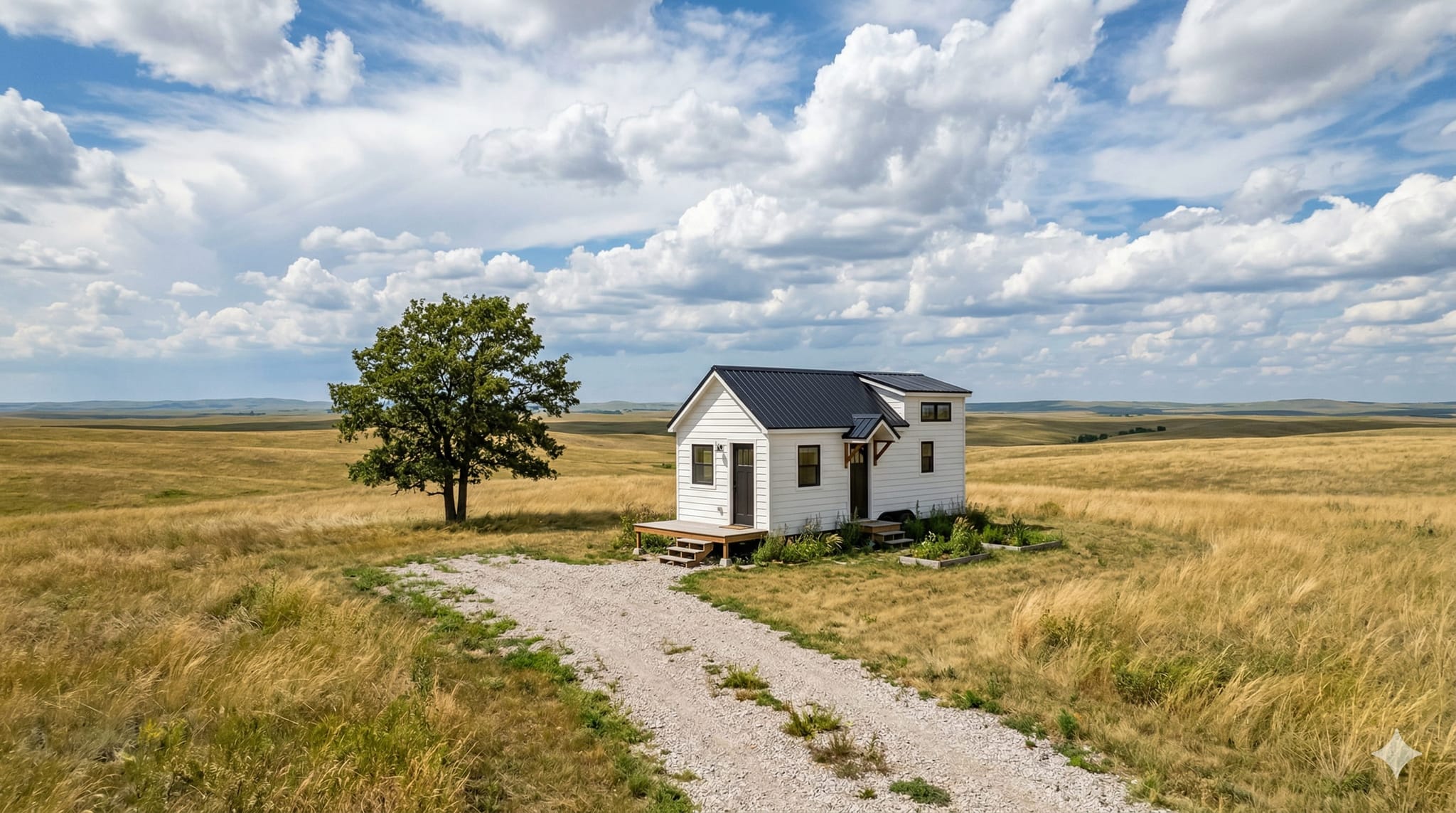
Fort Collins is the most ADU-friendly large city in Colorado as of April 2026. On February 14, 2025 (via Ordinance No. 009, 2025), the city updated its Land Use Code not only to comply with HB 24-1152 but to exceed the state minimums. ADUs are now allowed in every zone district where single-family homes are permitted — no overlays, no corner-lot restrictions, no neighborhood-character carve-outs. Approval is administrative, with staff review timelines of roughly 2–4 weeks for a straightforward modular ADU project.
ADUs in Fort Collins are typically capped at the lesser of 1,000 sq ft or 60% of the primary dwelling's size. Parking cannot be required beyond what already applies to the primary home under HB 24-1152. The city has a progressive planning posture consistent with its identity as a college town (Colorado State University) and regional sustainability leader.
Tiny homes on wheels fall under Colorado HB 22-1242 and are regulated by the state Division of Housing when built on a vehicle chassis under 400 sq ft. Inside Fort Collins city limits, THOWs as primary residences are generally limited to mobile home parks and RV parks with long-term spots; foundation-based tiny homes and ADU cottages are the cleaner path. Verify current requirements with your local planning department before purchasing land or beginning construction.
Verify current requirements with your local planning department.
As of April 2026, Fort Collins allows one ADU by right on any lot where single-family detached dwellings are permitted — this means every residential zone district in the city. ADUs are typically capped at the lesser of 1,000 sq ft or 60% of the primary home's size. Review is administrative; no public hearing is required, and staff approval for straightforward modular projects runs 2–4 weeks. Parking cannot be required beyond what the primary home already requires. Detached cottages, attached additions, garage conversions, and basement units all qualify. Owner occupancy of the primary home is not required under HB 24-1152, and HOAs cannot blanket-ban ADUs.
Communities, RV parks, and parking options in and near Fort Collins.
THOWs registered with the Colorado DMV are classified as trailers/RVs. In Fort Collins, long-term THOW parking typically means a licensed mobile home park or an RV park with long-term lease terms, with monthly rents in the $500–$800/mo range consistent with the broader Front Range. On-lot THOW placement as a full-time residence is not broadly permitted inside city limits. Residents interested in long-term tiny living are often better served by building a permitted ADU cottage on a single-family lot — Fort Collins allows this by right under the February 2025 Land Use Code update. Larimer County, outside city limits, is more permissive for rural THOW placement on private land.
co-housing
Fort Collins, CO (~3 mi NW of Old Town)
Cohousing community completed in 1997 with 30 energy-efficient townhomes on 16 acres clustered around a central green and common house.
co-housing
Fort Collins, CO (520 N Sherwood St)
Downtown Fort Collins cohousing community at 520 N Sherwood Street with shared values and consensus-based decision-making.
rv-park
Johnstown, CO (~25 min S of Fort Collins)
Long-term-only RV park at Johnson's Corner with 145 full hookups; explicitly requires stays of one month or longer and welcomes tiny houses alongside RVs.
rv-park
Loveland, CO (~30 min S of Fort Collins)
RV park along the Big Thompson River with permanent and semi-permanent residents living in park models, tiny homes, and RVs; monthly rates available.
rv-park
Johnstown, CO (~25 min S of Fort Collins)
Family-owned RV park at 648 NE Frontage Rd with 30/50 amp full hookups and roughly 100 sites; accepts overnight, short, and long-term stays.
Silt, Colorado
Family-owned tiny home builder headquartered in Silt, Colorado (Garfield County), building custom tiny homes to order since approximately 2021. Frontier Tiny Homes is located at 101 Owens Drive, conveniently off I-70 at Silt Exit 97. All homes are built to order — no pre-built inventory. Their lineup includes models ranging from compact single-level units to two-story designs such as the Perpetua, which features up to four bedrooms. Average build pricing is approximately $130,000 as of May 2026. The company lists Colorado tiny home community partners and ships builds to customers across the country. Frontier has a BBB business file and a Yelp profile with activity updated in January 2026, confirming active operations.
Service areas: Colorado
Wayne, Nebraska
Wayne-based modular home manufacturer building customizable homes across the central Plains since 1978. Heritage Homes offers ranch, two-story, prow, loft, cape cod, and cabin-series floor plans, with cabin models starting at 448 sq ft. All homes are built in a climate-controlled facility and delivered to an authorized Heritage Builder for site set and finish work. As of May 2026, the company lists 37 floor plans and serves buyers through a network of authorized builders across Nebraska, Iowa, Kansas, Colorado, Minnesota, Missouri, North Dakota, South Dakota, and Wyoming.
Service areas: Nebraska, Iowa, Kansas, Colorado, Minnesota, Missouri, North Dakota, South Dakota, Wyoming
Denver, Colorado
Denver-based ADU builder (legal name BRMI Denver ADU Corporation) specializing in custom, stick-built Accessory Dwelling Units across the Colorado Front Range. The founder previously worked with a national ADU builder and launched Kindred to address transparency and quality gaps common in the industry. All homes are constructed on-site using traditional stick-frame methods rather than off-site prefabrication. The company serves homeowners seeking extra living space for family, a home office, or an income-generating rental unit. Kindred is a member of the Home Builders Association of Metro Denver (HBA Denver) and has earned positive reviews on Trustpilot for transparent pricing and responsive service as of May 2026.
Service areas: Colorado
Longmont, Colorado
Woman- and family-owned ADU builder based in Longmont, Colorado, specializing in detached Accessory Dwelling Units for homeowners across the Front Range and beyond. Founded by native Coloradan Christy Silva alongside her father Dave, who has built Colorado homes for more than 25 years as of May 2026. Little Home Builder offers three pre-designed ADU models — The Autumn (1 bedroom), The William (2 bedrooms), and The David (1 bedroom above garage) — each available in Urban Farmhouse, Modern Shed, or Craftsman Cottage exterior styles. All units are built on a foundation on the homeowner's property. Each build includes a 7-year structural warranty and a 1-year workmanship warranty. The company serves Denver, Boulder County, Colorado Springs, and the broader Colorado statewide market.
Service areas: Colorado
Denver, Colorado
Denver-based design/build firm specializing in Accessory Dwelling Units (ADUs) and tiny homes across Colorado. Founded in 2024 by a woman-owned team, Rocky Mountain ADUs manages every phase — from zoning feasibility and permitting through design, construction, and final inspections — with typical project timelines of 6–9 months. Their portfolio spans studio backyard ADUs, two-bedroom units, backyard offices, and pool houses, all built on-site rather than prefabricated off-site. Pricing starts around $140,000 and reaches $290,000 depending on size, finishes, and site complexity as of May 2026. The company earned BBB accreditation in January 2025 and was named a finalist for the 2025 BBB Spark Award for Entrepreneurship. All projects include a 1-year workmanship warranty plus manufacturer warranties on materials.
Service areas: Colorado
Durango, Colorado
Durango, Colorado tiny home builder specializing in custom tiny houses on wheels (THOW). See their site for current availability, models (including the “Front Range”), and intake process.
Service areas: Colorado, United States
A comparison between tiny-home living and conventional homeownership in Fort Collins.
Tiny home path
Traditional home path
Potential monthly savings
2050
Source: Redfin Fort Collins market data, February 2026
Verified links for planning, permitting, and community connections in Fort Collins.
Yes, by most measures. The February 2025 Land Use Code update allows ADUs in every zone district where single-family homes are permitted, with no overlays or neighborhood-character carve-outs, and uses administrative review with 2–4 week approval timelines. That is broader than Denver or Colorado Springs, both of which apply more conditions.
Generally the lesser of 1,000 sq ft or 60% of the primary dwelling's size. Actual caps depend on the zone district and lot — check with Fort Collins Zoning Services before finalizing plans.
No. HB 24-1152 prohibits owner-occupancy requirements, so you can rent both the primary home and the ADU long-term (30+ day terms).
Not as a full-time primary residence on a standard single-family lot. THOWs are DMV-registered as trailers and are generally restricted to mobile home parks or long-term RV parks inside city limits. Larimer County, outside the city, offers more flexibility for rural THOW placement.
For a straightforward modular ADU project, staff review typically takes 2–4 weeks. Custom site-built ADUs with utility-connection complexity can take longer. There is no public hearing requirement.
Guides, zoning explainers, and financing articles related to this state.
Everything you need to know about living in a tiny home in California — legal pathways, best cities, costs by region, builders, financing, insurance, and off-grid options. Updated for 2026 laws.
A state-by-state breakdown of tiny home zoning laws, THOW regulations, ADU rules, and where tiny homes are easiest to place legally in 2026.
A state-by-state overview of tiny home zoning laws, covering the most friendly and most restrictive states for THOW and foundation tiny home placement.